Explain Different Phases of Disaster Management
Disasters management mainly aims to. Reduction of runoff is one of the very effective methods of flood disaster management.
Icts 4 Disaster Management
The model helps frame issues related to disaster preparedness as well as economic and business recovery after a disaster.

. Disaster management programs are covered. Readiness to deal with any disaster. Disaster management coordinates all aspects of disaster response aiming to effectively mobilise the required equipment resources staff and aid needed to assist people affected by disasters.
Minimize sufferings to the maximum possible extent. This paper deals with the four phases involved in the disaster cycle. The four phases of disaster management Mitigation.
Mitigation is the use of strategies to reduce risks prior to during and post disaster. It differs from the response phase in its focus. The concepts presented in this session are designed to provide a basic understanding of disasters and their management.
Prevention of threat of disasters. During high flood stages the Control Room of the forecasting centre works round the clock and keeps informed the flood fighting agencies about the latest river position. 1 Reduce or avoid losses from hazards.
The Disaster Management Cycle. Actively Preparing for Emergencies. Saving lives of all living organisms.
Recovery efforts are concerned with issues and decisions that must be made after immediate needs are addressed. 2 Assure prompt assistance to victims. 86 Explain the evolution of disaster management programs.
Concepts such as the four disaster phases the major agencies involved with disasters and a brief history of US. To reduce the potential for human material or environmental losses caused by hazards. Mitigation Measures to be taken before and after an event 2.
Goals of Disaster Management. It consists of a number of elements for example. Disaster response is the second phase of the disaster management cycle.
Disaster management aims to reduce or avoid the potential losses from hazards assure prompt and appropriate assistance to victims. They work in close collaboration. In order to understand the principles of disaster mitigation it is important to clearly understand the phases of disaster management cycle like mitigation preparedness response relief recovery and disaster management.
Control and oversight of a disaster response is a. 3 Achieve rapid and effective recovery. The first reason why disaster management is important is because it oversees the response to a disaster.
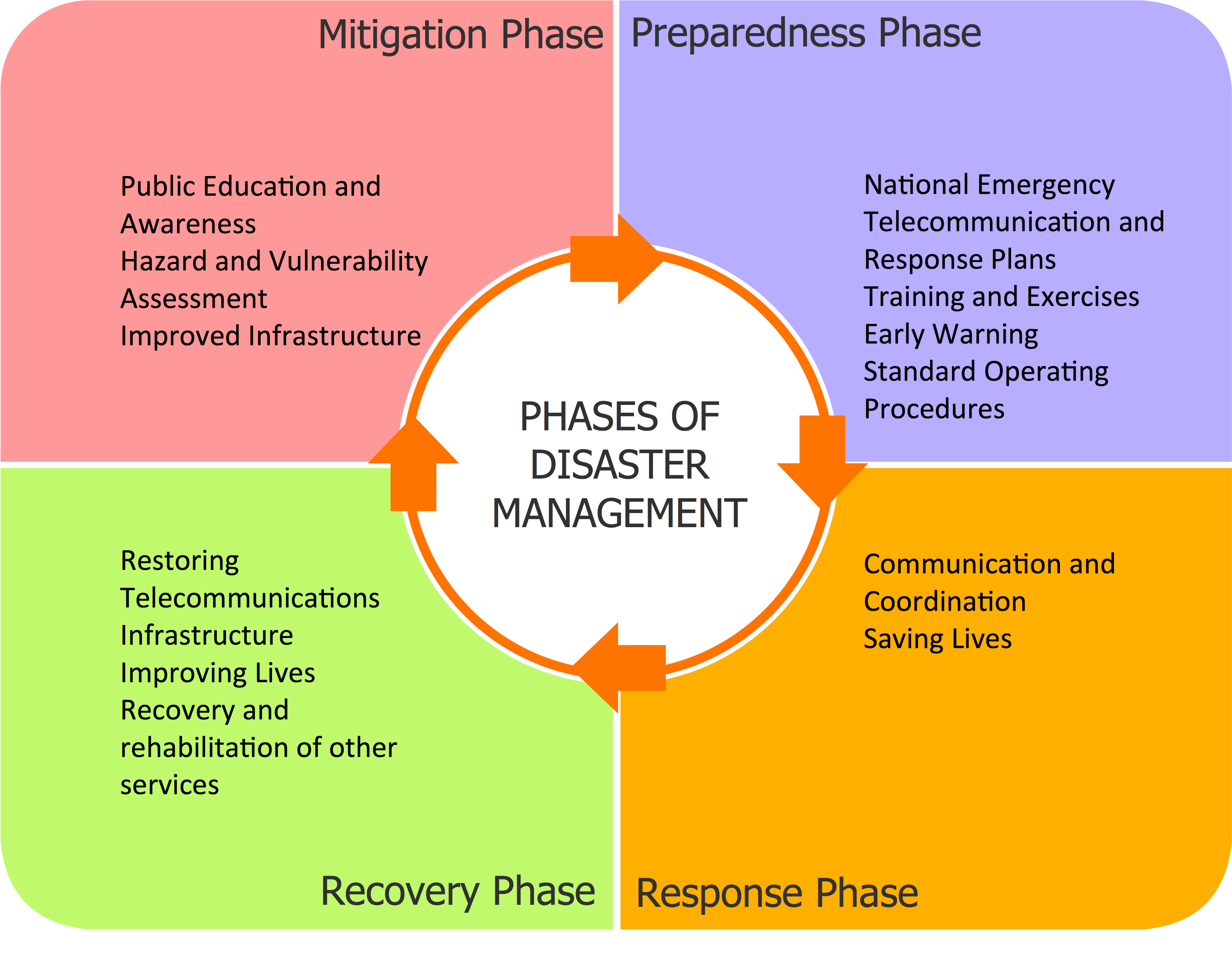
There are three key stages of activities in disaster management. Protect and restore livelihoods. Those phases are the mitigation phase the preparedness phase the response phase and the recovery phase.
It also involves a systematic approach to managing the responsibilities of disaster prevention preparedness response and recovery. Components of Disaster Risk management. The preparedness phase occurs before an emergency occurs but is still a continuous process with room for constant improvement.
Preventing future emergencies or minimizing their effects Includes any activities that can prevent or reduce the chance of occurrence of an emergency or reduce the damaging effects of unavoidable emergencies. Preparedness Measures to be taken before and after an event 3. Disaster risk management DRM is a systematic application of management policies procedures and practices to the tasks of identifying analyzing evaluating treating.
The aim of the recovery phase is to restore the affected area to its previous state. Integrating the following four aspects into all parts of the development process leads to sustainable development and lessens post. Promptness in dealing with a disaster.
The following diagram illustrates the relationship of the four phases of emergency management. Mitigation Preparedness Response and Recovery. The Disaster Management Act of 2005 defines Disaster Management as an integrated process of planning organizing coordinating and implementing measures which are necessary for-Prevention of threat of any disaster.
Reduction of risk of any disaster or its consequences. Disaster management is a process of effectively preparing for and responding to disasters. The Disaster Management Cycle.
Response Measures to be taken during and immediately after an event. Before a disaster to reduce the potential for human material or environmental losses caused by hazards and to ensure that these losses are minimized when the disaster actually strikes. The four phases of disaster.
Though there are similarities in some like mitigation and preparedness being done before a disaster and response and recovery occurring after a disaster they each have their own unique ways in. It involves strategically organizing resources to lessen the harm that disasters cause. Key Phases of Disaster Management There are three key phases of activity within disaster management.
The significance of the emergency management cycle is that all communities are in at least one phase of emergency management at any time. Readiness to deal with disasters. Preparedness is a whole toolkit of planning organizing training exercising equipping and evaluating disaster response.
Provisional storm drains or diversion dams. Warningevacuation search and rescue providing immediate assistance assessing damage continuing assistance and the immediate restoration or construction of infrastructure ie.

The Four Stages Of The Disaster Management Cycle Download Scientific Diagram

The Phases Of The Disaster Management Cycle And Examples Of Related Download Scientific Diagram
The Four Phases Of Disaster Management Download Scientific Diagram
No comments for "Explain Different Phases of Disaster Management"
Post a Comment